Solving a Rubik’s Cube fast, with confidence, usually comes down to one thing: memorized algorithms. These sequences of moves help you handle the tricky cases especially on the last layer. But memorization can feel overwhelming: lots of weird notation, many algorithms, confusing cases.
In this guide, we’ll walk you through easy, proven methods to memorize the algorithms of a 3×3 Rubik’s Cube. Whether you’re just starting or improving your speed, these techniques will help you recall the right moves faster, reduce hesitation, and build muscle memory.
What Are Algorithms & Why They Matter
- Definition: An algorithm is a sequence of moves (like R, U, F, R′, etc.) used to move pieces in the cube in a specific way.
- Role in Solving: Most solution methods (e.g. the beginner’s method, CFOP, etc.) use algorithms for orienting and permuting the last layer, inserting edges/corners, etc.
Benefit of Memorization:
- Faster solves you won’t pause to think what to do next.
- Fewer mistakes smoother execution.
- More consistency, same cases, same reactions.
Basic Notation & What to Understand First
(To memorize well, you need to understand before you memorize.)
- Moves / Faces: U (Up), D (Down), L (Left), R (Right), F (Front), B (Back)
- Primes and Inverses: A move followed by ′ (prime) means counterclockwise, without means clockwise. Example: R′ means rotate the Right face counterclockwise.
- Double Moves (“2”): e.g. U2 means rotate Up face 180°.
- Case Recognition: Many algorithms are used when the cube is in a certain pattern being able to see that pattern (case) quickly is just as important as knowing the algorithm.
Techniques for Memorization
Here are techniques you can use to make algorithm memorization more effective:
1. Break into Chunks & Use Triggers
- Triggers are short, common sub-sequences that appear in many algorithms (e.g. “R U R′ U′”, “F R U R′ F′”). Once you recognize a trigger, you’ll know a big part of the algorithm.
- Break longer algorithms into smaller segments. Practice each segment slowly, then connect them together.
- Example: Suppose an algorithm is R U R′ U′ R U2 R′. You might split into R U R′ U′ + R U2 R′.
2. Visualize / Understand What Moves Do
- Don’t just memorize the letters try to see what pieces are moving. For instance, notice how corners rotate, edges swap.
- Imagine or sketch (mentally or on paper) before executing. If you “see” what the algorithm is doing, your memory link is stronger.
3. Repetition & Spaced Practice
- Practice algorithms slowly at first: speed isn’t as important as accuracy.
- Do “drills” where you repeat each algorithm multiple times per session.
- Use spaced repetition: revisit algorithms after 1 day, 3 days, 1 week, etc. This helps long-term retention.
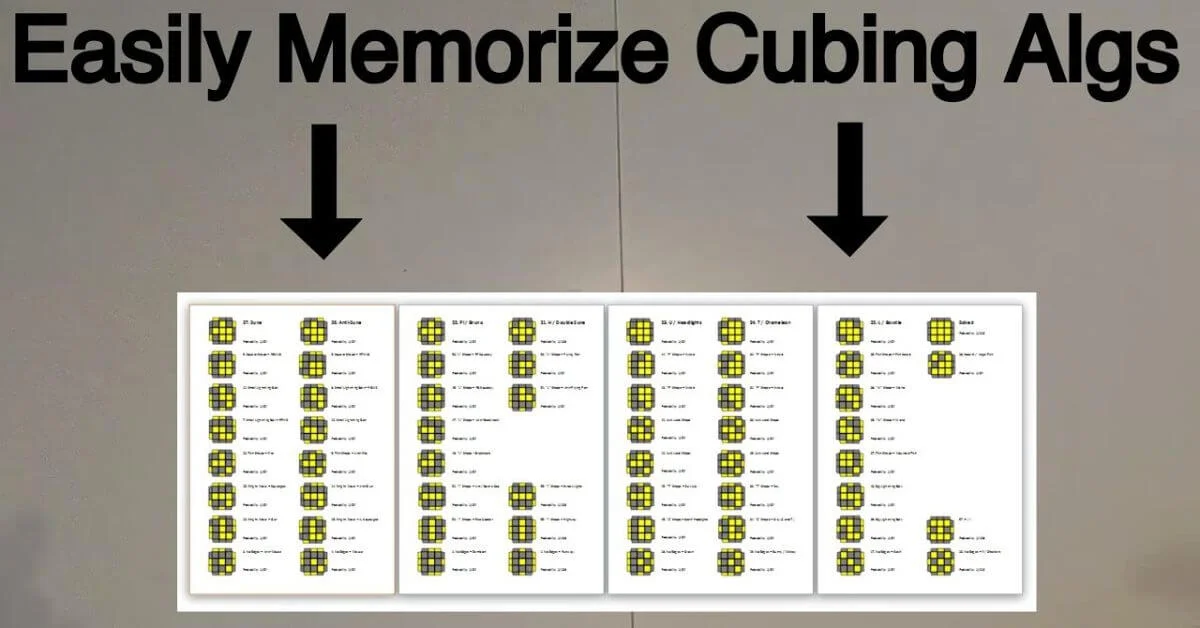
4. Flashcards / Visual Aids
- Physical or digital flashcards: front side shows the case-pattern (or name), back side shows the algorithm.
- Use images, diagrams or color maps alongside notation — helps visual learners.
- Self-quiz: try to recall the algorithm from memory, then check.
5. Explain / Teach Others & Use Community
- Teaching someone else forces you to clarify your understanding (helps memory).
- Discussing cases and algorithms in cubing forums or groups helps reinforce what you know and expose you to variations.
- Observe others solving; seeing how they use algorithms (and their hand movements) gives cues you can adopt.
6. Use Consistency & Patience
- Don’t try to learn many new algorithms at once. It’s tempting, but leads to mixing them up.
- Focus on a few, master them, then add more.
- Be patient, memorization improves over time with regular practice.
A Sample Practice Plan (7 Days)
Here’s a practice plan you can follow. Adjust as needed based on how much time you can spend each day.
| Day |
Goal |
What to Do |
| Day 1 |
Learn 2 basic algorithms + notation |
Understand the case for each algorithm; write them down; practice slowly (5-10 reps each) |
| Day 2 |
Chunking & triggers |
Split both algorithms into “triggers” or sub-chunks; practice those parts separately |
| Day 3 |
Flashcard + recall |
Create flashcards; test recall without looking; check mistakes, redo weak parts |
| Day 4 |
Speed practice |
Increase speed slightly; execute whole algorithm multiple times; focus on smooth turns |
| Day 5 |
Add new algorithm(s) |
Introduce 1-2 more algorithms; use same process: understand, split, practice |
| Day 6 |
Mixed practice |
Mix old and new algorithms; go through all; time yourself; track mistakes |
| Day 7 |
Review and wrap up |
Review all algorithms; check retention; see which still need work; plan next week’s learning |
Common Pitfalls & How to Avoid Them
| Pitfall |
Why It Happens |
What to Do Instead |
| Trying to learn too many at once |
Overwhelm → confusion |
Limit to 2-3 new ones per session; build gradually |
| Practicing moves without understanding |
You’ll mix up patterns or forget easily |
Understand the purpose and visualize what changes each algorithm makes |
| Moving too fast too early |
Sloppy execution; mistakes become habits |
Practice slow first; perfect the movement; then speed up |
| Not revisiting old algorithms |
Forgetting; decline in accuracy |
Include review in every session; spaced repetition works best |
| Relying only on memory tricks without physical practice |
Recognizing isn’t enough without doing |
Always execute physically; muscle memory matters |
Advanced Tips (For When You’re Comfortable)
- Mnemonics & Stories: Create short stories or phrases linking the case-pattern and the algorithm.
- Visual Mapping / Color Cues: Use the colors on your cube to create visual “landmarks” for case recognition.
- Algorithm Sets & Method Choices: When you advance (e.g. CFOP method), you’ll need many more algorithms (OLL, PLL, F2L variations). Prioritize learning the most used ones first.
- Video & Slow-Motion Review: Watching videos of algorithms executed slowly helps you see hand motions, look-ahead, grip changes.
- Use Tools / Apps: There are apps and online tools where you can input case name → see the algorithm; some generate diagrams. Useful for reinforcement.
FAQ
How many algorithms do I really need to memorize?
It depends on the method you use. For basic (“beginner”) methods, maybe 7-15. For full CFOP: dozens of OLL + PLL cases. But you can start small and expand.
How long until I can recall them easily?
With daily practice, many people feel confident with a few new algorithms in 3-7 days. For full mastery, perhaps several weeks or months depends on consistency.
Should I memorize while using the cube only, or also off-cube?
Both. Practicing physical execution is essential. But doing flashcards, sketching cases, visualizing off-cube helps reinforce memory when you’re away from your cube.
Is speed more important or accuracy first?
Accuracy always comes first. If you practice sloppy moves you’ll reinforce bad habits. Speed comes naturally as you become precise and familiar.
Conclusion
Memorizing Rubik’s Cube algorithms doesn’t have to be frustrating. The key is combining understanding + chunking + regular, mindful practice. Start with a few, use triggers, flashcards, and spaced repetition. Be patient with yourself. Over time you’ll notice your solve times dropping and your confidence rising.
If you’d like, download our free printable algorithm cheat sheet here at Cubing Colours perfect for beginners to keep on hand. Also check out our articles: How to Solve a Rubik’s Cube 3×3 for Beginners and Speedcubing Tips & Techniques.